

The Silent Partner series: Introducing the other half of the IVF couple
So much of the IVF discourse revolves around the intended mum: in this series, my husband gives an insight into life as the non-medication-taking half of an IVF couple
The question of "how did we get here?" requires me to cast my mind back to approximately the year 2000. As Helen will attest, my memory isn’t always quite perfect. And, as a young 14-year-old, the life-changing consequences of what I learned that year were not immediately apparent to me. So, despite the significance of what I learned about myself that year, some of my recollections need to be taken with a pinch of salt.
Now, here’s the (hopefully accurate) history. At some point in 2000, I found a small lump on my head (on top, under the hair). Being a not entirely un-sensible teenager, I told my mum, who immediately made me an appointment with my GP (and doesn’t that date this story?). At the appointment, the GP decided there and then to grab a scalpel and remove this small lump to send for biopsy. Eep. The net result of this was an appointment at Guy's genetic clinic. After a brief examination of my skin (checking for café au lait patches) and some examination of further similar small lumps elsewhere on my body, I was diagnosed with NF1, which you’ll already have read about here. And that was it. No follow-ups suggested. No treatment needed. No monitoring suggested. Thank you and goodbye. All pretty unglamorous for something that, decades later, would have a profound effect on my life and the life of my partner.
I have no recollection of having discussed the implications for having future children. That’s not to say it didn’t happen. It may well have washed over my head as a teenager. There was also no genetic testing, either. A visual diagnosis was (rightly) considered sufficient, given my obvious symptoms. This meant that neither I nor my parents would have known if I had inherited the NF1 from them or if it was just a random mutation, although all indications would have been that this was a non-inherited condition.
I wonder now if the relatively benign nature of the meeting with Guy’s (no testing, no follow-ups etc.) gave the teenage me the impression this was no big deal. Additionally, my presentation of NF1 is extremely mild. I have no visible neurofibromas, no bone or joint problems that I am aware of and do not suffer from the learning difficulties that can occur with NF1.
This means that, in many ways, NF1 slipped from my mind shortly after the appointment. The condition didn’t, and thankfully still hasn’t, worsened over the last quarter-century. And as my 20s and most of my 30s passed, I didn’t meet a partner where having children seemed even like a distant possibility.
All this means that NF1 never has never been part of my ‘being’, in the sense that it forms no part of my sense of self. It isn’t part of my personality; it doesn’t influence the way I see the world. It just ‘is’. It’s just genetics. It’s no more relevant to how I see myself than the colour of my hair or eyes.
But of course, now it is so much more than just genetics. I have met someone. I do want to have children with them. NF1 is no longer ‘just a thing’. It’s everything. It’s part of my – our – future in a way I didn’t see coming before meeting Helen.
So, what does this mean for me now? Helen has already covered elsewhere the genetic testing needed as part of the PGT-M process. That was, much like the childhood appointment with Guy’s, a process requiring little fanfare. Just a simple blood test and the genetic confirmation of the condition followed. The strangest thing since the test results confirmed the diagnosis has been how disconnected I sometimes feel from the rest of the IVF process.
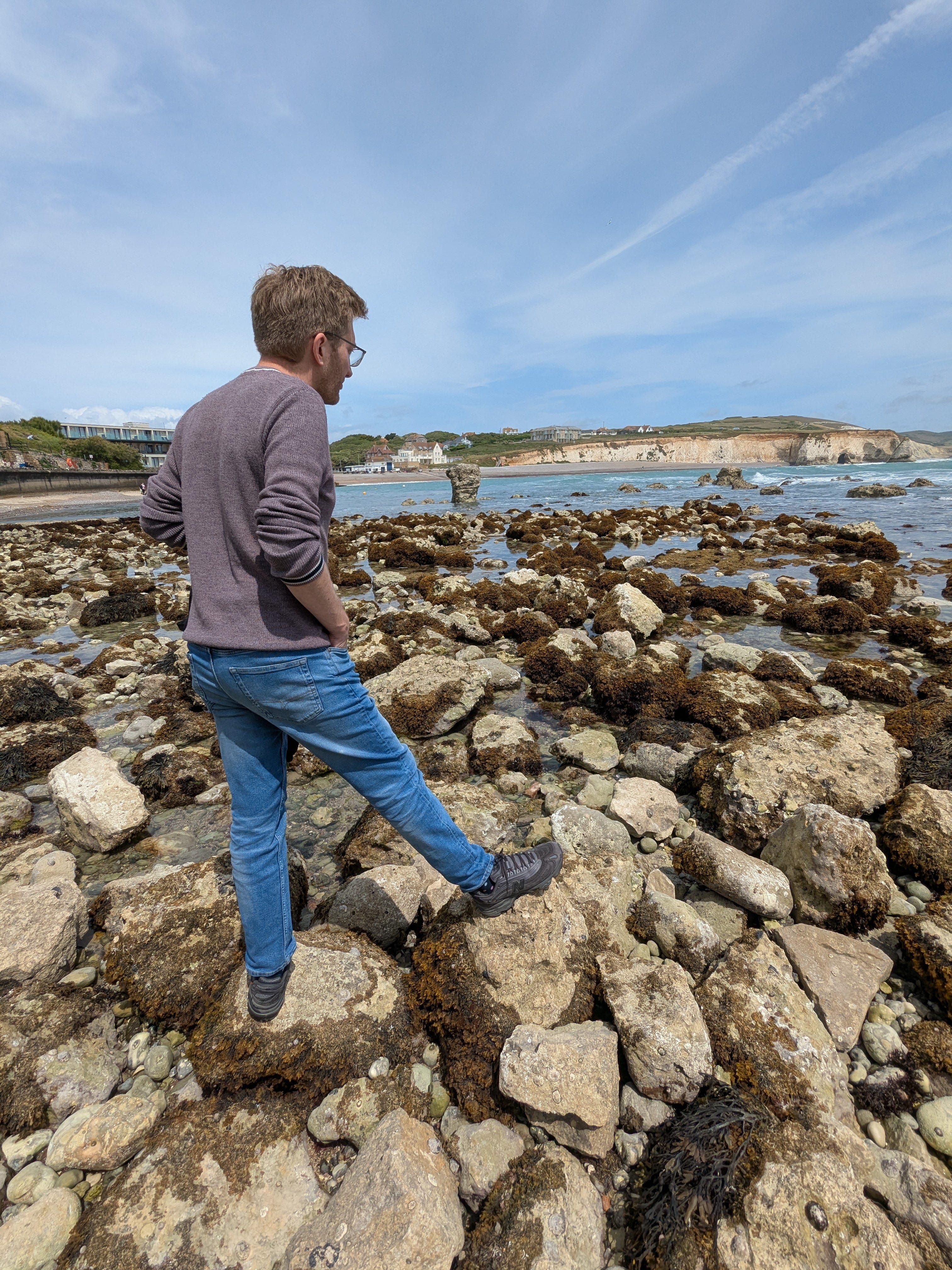
Everything we are doing is because of me. But I have had little of a role to play since the genetic diagnosis. Everything, all the difficult things, fall on Helen. The endless medication. The discomfort and intrusiveness of the scans. All this leaves me with a feeling not so much of guilt, but of sadness that all this is necessary – or at least, necessary if we are to have any chance of a family.
I suspect that men will often find themselves feeling a bit cut out, even where they are the ‘cause’ of the need for IVF treatment, as I am. This is fair enough, for the most part. We men do not bear children, are not the principal focus of any of the IVF treatment and, frankly, our main role (where male infertility isn’t part of the reason for treatment) is that of sperm donor.
Nonetheless, when you are entering into something this intense as a couple, it would be nice at times to be better kept in the loop by those providing the treatment. If both parties consent, I don’t see why, for example, elements of the treatment that relate to both of us couldn’t be shared with both of us automatically. The genetic testing results for the embryos, for example. But such is the extent to which men are cut out of the IVF process, the NHS sent the results of my genetic test for NF1 to Helen. I’m still not sure if I’m more amused, bemused or outraged by that.
In the grand scheme of things, these could be considered minor gripes. I’m still sitting here writing this in comfort, free of the effects of a barrage of hormone buggering medication. I also feel I should say that none of the above is a complaint about our clinicians at LWC, who have been wonderful. Most importantly, whatever the outcome, all of this will not be something we regret doing – but the impact it has on Helen hangs heavily on me.

I love this series! I’m not sure I’ve ever read anything about the male partner’s perspective in the infertility journey. I’ve often resented my husband for how he seemingly “gets” to avoid so much of this stuff, but I know he feels it too, just differently. I also wish infertility was framed more as a challenge for women AND men. I hear it so much as a women’s issue or that women are struggling with infertility, but regardless of what the issue is, it definitely impacts men too. Thank you for sharing this!
Appreciate this perspective, it hadn’t occurred to me how alienating it must be for all the results to go to the female partner (or the partner undergoing treatment). I’d love for my husband to feel more involved and take on more of the admin side of treatment but how can I when it’s all aimed at me?